
◦ Technical reference · Ulva ohnoi · Cartaya, Huelva
The Ulva biostimulant: what it is and how it works
An Ulva biostimulant is an agricultural product derived from the green alga Ulva. Its characteristic compounds are ulvans, sulfated polysaccharides that act as elicitors: they do not feed the plant, they switch on its own defence mechanisms. Extracts also supply amino acids and compounds with hormone-like activity.
◦ Updated August 2026
What Ulva is
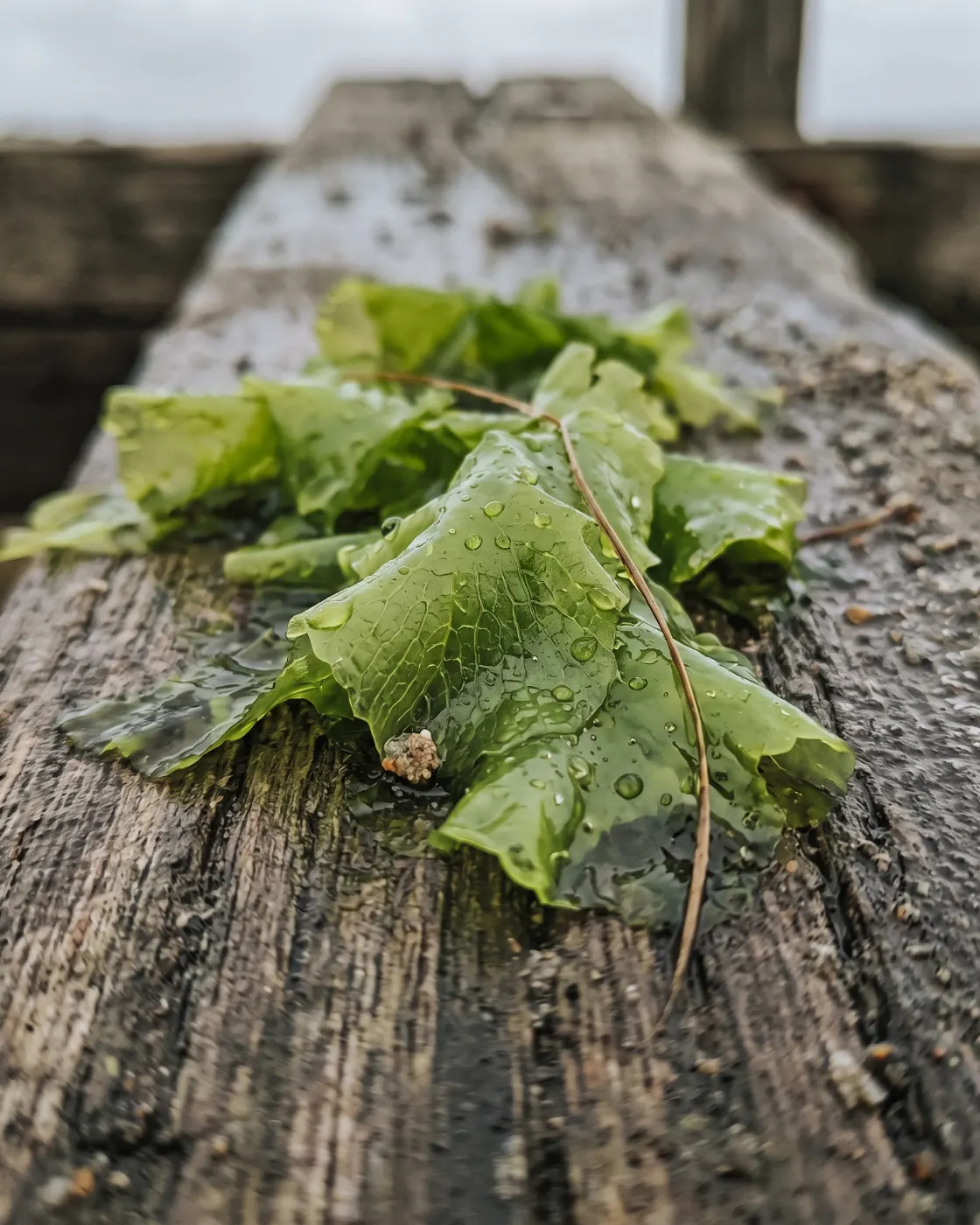
Ulva is a genus of green algae — commonly known as sea lettuce — growing in shallow coastal waters. Unlike the brown algae that dominate the biostimulant market, it is a green alga, and that difference is not taxonomic housekeeping. It is chemistry.
The species we cultivate is Ulva ohnoi, grown in the Río Piedras marshes in Cartaya, Huelva, Spain.
Ulvans: what they are and why they matter
The compounds that characterise Ulva are ulvans: sulfated polysaccharides, rich in rhamnose and uronic acids, that brown algae do not contain.
What matters is not the name but the mode of action. Ulvans are studied as elicitors.
What an elicitor is, without the jargon: every plant has its own defence mechanisms. They are there, but they do not always switch on in time. An elicitor signals the plant to activate them before the challenge arrives.
A fungicide and an elicitor work in opposite ways: a fungicide acts on the pathogen; an elicitor acts on the plant. That is precisely why it does not replace one — it fits alongside it in the programme.
What else it contains
Alongside ulvans, the extract supplies amino acids, β-carotenes and 11 naturally occurring phytohormones, plus alginic acid and water-soluble magnesium, potassium and phosphorus. Extraction is cold, to avoid degrading heat-sensitive compounds.
This is a biostimulant profile, not a fertiliser one: the magnesium, potassium and phosphorus are part of the alga's natural composition, not there to feed the crop.
Why cultivated rather than wild-harvested
Most seaweed extracts on the market start from biomass harvested from the wild. Cultivation changes three things:
- Harvest is planned. It does not depend on season or harvesting permits.
- The profile stays consistent between batches. Less variability at the starting point.
- Every batch traces back to its origin — to the pond, not to the middleman.
For anyone formulating a product or buying at volume, those three points decide the purchase.
Where it has been studied
The use of Ulva ohnoi in viticulture was investigated in the SEAWINES project (2021–2025), funded by Spain's AEI/MCIN, in relation to grapevine defence response against Plasmopara viticola, the downy mildew pathogen. Partners: IFAPA, UPV/EHU, ICVV and NEIKER.
SEAWINES project (2021–2025), funded by AEI/MCIN, on the effect of Ulva ohnoi extract on grapevine defence response against Plasmopara viticola.
When Ulva makes sense — and when it doesn't
- When elicitation is the route of interest, not nutrient supply alone.
- When origin and traceability are part of the purchasing specification.
- When you are developing your own product and need an ingredient with plannable supply.
And when it doesn't: if what you need is specifically the Ascophyllum nodosum profile, the honest answer is that Ulva is a different thing.
FAQ
What are ulvans?
Sulfated polysaccharides characteristic of algae in the Ulva genus, rich in rhamnose and uronic acids. They are studied for their capacity to act as elicitors of plant defences.
Does an Ulva biostimulant replace a fungicide?
No. An elicitor acts on the plant, not on the pathogen. It fits into the crop protection programme; it never replaces it.
How does it differ from an Ascophyllum extract?
In species and in chemistry. Ascophyllum nodosum is a brown alga with alginates, mannitol and cytokinin-like compounds. Ulva is a green alga with ulvans. Different mechanisms.
What is Ulva ohnoi?
A green algal species in the Ulva genus. It is the one we cultivate in the marshes of Cartaya, Huelva.
Can it be bought in bulk?
Yes. We supply raw material, custom extracts and formulated biostimulants, from drums to tanker loads.
◦ Next