◦ Species comparison · green alga versus brown alga
Ulva versus Ascophyllum nodosum: what actually differs
Ascophyllum nodosum is a brown alga from the North Atlantic, wild-harvested, containing alginates, mannitol and cytokinin-like compounds. Ulva is a green alga whose characteristic compounds are ulvans, sulfated polysaccharides with elicitor activity. Neither is better: they act through different mechanisms and are sourced in different ways.
◦ Updated August 2026
Why this comparison matters
When a buyer evaluates seaweed biostimulants, the first technical criterion is the species. And most labels say “seaweed extract”, which says nothing at all.
This page compares the two honestly. We are not going to claim Ulva is better — that would be easy and it would be false. What we will do is set out how they differ, so the decision gets made with the information in view.
| Criterion | Ascophyllum nodosum | Ulva |
|---|---|---|
| Group | Brown alga (Phaeophyceae) | Green alga (Chlorophyta) |
| Common name | Knotted wrack | Sea lettuce |
| Usual sourcing | Wild-harvested, North Atlantic | Can be cultivated |
| Characteristic polysaccharides | Alginates, fucoidans | Ulvans (sulfated, rhamnose-rich) |
| Other cited compounds | Mannitol, betaines, cytokinin-like activity | Amino acids, hormone-like compounds |
| Most studied mode of action | Nutritional and anti-stress | Elicitation of plant defences |
| Market presence | Dominant | Minor |
| Supply | Subject to season and permits | Plannable when cultivated |
The difference that weighs most: mechanism
Ascophyllum has mainly been studied for its effect on development and on tolerance to abiotic stress: drought, salinity, temperature.
Ulva is studied mainly along the ulvan route: elicitation of the plant's defence response.
They are not the same tool. If the objective is to carry a crop through water stress, there is a large body of literature on Ascophyllum. If the objective runs through the defence response, the ulvan route is the one under investigation.
The second difference: where each one comes from
This is the part that is rarely discussed and that affects volume buyers most.
Ascophyllum nodosum is harvested from Atlantic shorelines. It is a wild resource: subject to season, to permits, and to the natural variability of each area and each year.
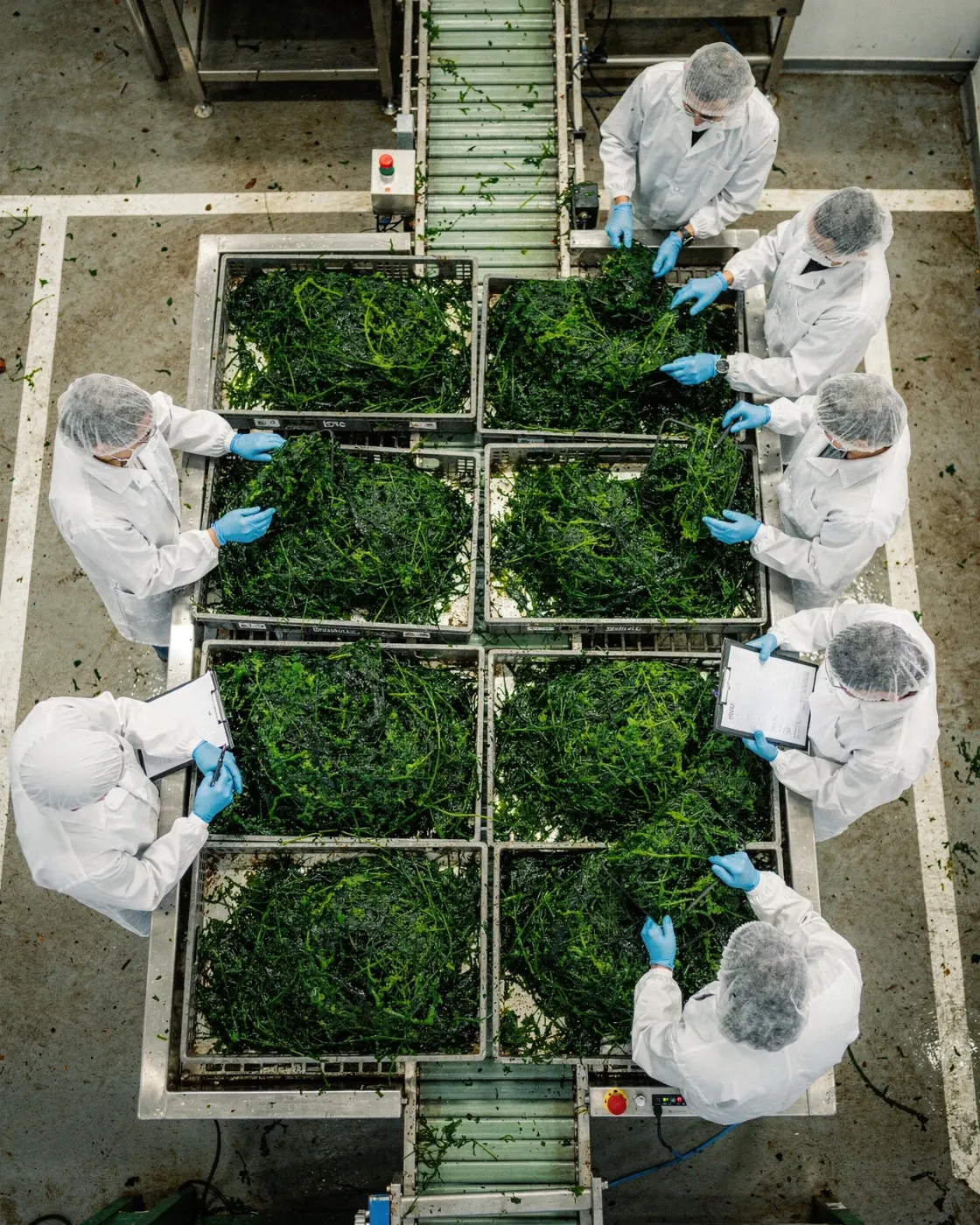
Ulva can be cultivated. And when it is, supply becomes plannable, the profile stays more consistent between batches, and every batch traces back to the pond it came from.
For a formulator or a distributor, this is not an environmental footnote. It is supply predictability.
What this comparison does NOT say
Three things, for honesty:
- We are not saying Ulva performs better. Comparing two species would require head-to-head trials in the same crop and conditions, and we do not have them.
- Ascophyllum has far more accumulated literature. It has been on the market for decades. That is a fact, and it counts in its favour.
- Within the same species, extraction method changes the outcome. Two extracts from the same alga may have little in common.
So, when Ulva?
- When elicitation is the route of interest.
- When origin, traceability and supply predictability form part of the specification.
- When you need to differentiate a catalogue that already carries three Ascophyllum products. A distributor whose entire seaweed range rests on one species is not diversifying anything.
Ulva ohnoi extract was studied in the SEAWINES project (2021–2025), funded by AEI/MCIN, on grapevine defence response against Plasmopara viticola.
FAQ
Which of the two algae is better?
Neither, in the abstract. They act through different mechanisms. The useful question is not which is better, but which fits the crop objective.
Can I swap an Ascophyllum product for an Ulva one?
Not automatically. They are not equivalent in composition or mechanism. Treat it as a different product with its own fit.
Why are almost all seaweed biostimulants Ascophyllum-based?
Market history: decades of use and a large body of published work. Not because other species do not work.
What is an elicitor?
A substance that activates the plant's own defence mechanisms ahead of the challenge. It acts on the plant, not on the pathogen.
Can Ulva be cultivated and Ascophyllum not?
Ascophyllum nodosum is commercially exploited through wild harvesting. Ulva is cultivated — which is what we do in Huelva.